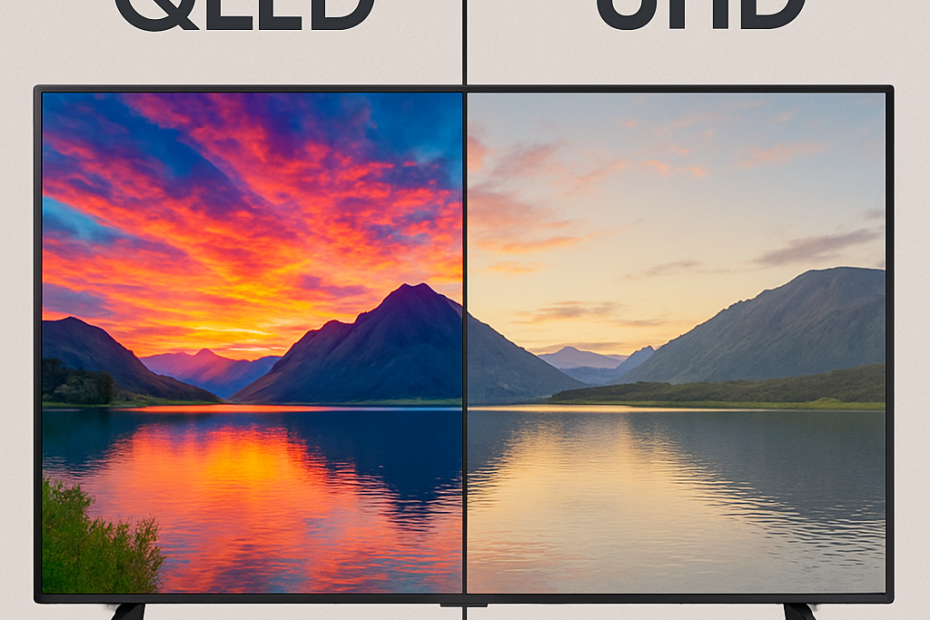
When shopping for a new TV, you might come across terms like QLED and UHD. But what do they mean, and how do they differ? Understanding these terms can help you make the right choice for your home entertainment setup.

Understanding QLED and UHD
Before diving into which is better, it’s important to understand what QLED and UHD mean.
What is QLED?
QLED stands for Quantum Dot Light Emitting Diode. It’s a technology developed by Samsung that uses quantum dots to enhance brightness and color. These dots are tiny particles that emit light when struck by photons from an LED backlight, resulting in more vibrant and accurate colors.
QLED TVs are essentially LED TVs with an added layer of quantum dots. They offer improvements in color accuracy and brightness over traditional LED displays but still rely on backlighting.
What is UHD?
UHD stands for Ultra High Definition. It refers to the resolution of the display, specifically 3840 x 2160 pixels. This resolution is commonly known as 4K, offering four times the detail of Full HD (1080p). UHD is a standard that defines the number of pixels, but it doesn’t specify the type of technology used in the display.
Key Differences Between QLED and UHD
Now that we know what QLED and UHD mean, let’s explore the key differences.
Resolution and Picture Quality
While UHD is about resolution, QLED is about display technology. UHD ensures you have a high-resolution display, which is crucial for picture clarity, especially on large screens. However, resolution alone doesn’t determine picture quality.
QLED technology enhances the viewing experience by improving brightness and color accuracy. This means that a QLED TV can make UHD content look even better, but it doesn’t necessarily mean it’s the best for everyone.

Color and Brightness
When it comes to color and brightness, QLED stands out. The quantum dots in QLED TVs allow for a wider color gamut and higher brightness levels. This makes QLED TVs excellent for bright rooms or watching sports and action-packed movies.
In contrast, UHD doesn’t impact color or brightness directly; it focuses on delivering a high number of pixels for detailed images.
Viewing Angles
Viewing angles refer to how well a TV maintains picture quality from different positions. QLED TVs generally have better viewing angles than regular LED TVs, but they may still fall short compared to OLED displays, which offer superior angles.
Cost Considerations
Price can be a significant factor in choosing a new TV. QLED TVs, with their enhanced features, often come at a premium compared to standard UHD TVs. However, the price difference is narrowing as technology advances and more manufacturers produce QLED models.
QLED vs. OLED: How Do They Compare?
It’s also helpful to understand how QLED compares to another popular technology: OLED.
What is OLED?
OLED stands for Organic Light Emitting Diode. Unlike QLED, OLED technology doesn’t require a backlight. Instead, each pixel emits its own light. This allows for perfect blacks and superior contrast because pixels can be turned off individually.
Key Differences Between QLED and OLED
- Brightness: QLED TVs are typically brighter than OLED TVs, making them suitable for well-lit rooms.
- Contrast and Black Levels: OLED TVs offer better contrast and black levels because of their ability to turn off individual pixels.
- Color Accuracy: Both offer excellent color accuracy, but OLED may have a slight edge in delivering true-to-life colors.
- Burn-In Risk: OLED TVs can suffer from burn-in if static images are displayed for extended periods. QLED TVs do not have this issue.
UHD vs. QLED: Which Should You Choose?
When deciding between UHD and QLED, consider your viewing habits and environment.
When to Choose UHD
- Budget-Friendly: If you’re looking for an affordable option, a standard UHD TV might be the best choice.
- Resolution Focused: If you prioritize resolution and have a tighter budget, UHD delivers excellent picture quality.
When to Choose QLED
- Enhanced Viewing Experience: If you want vibrant colors and high brightness, QLED is a better choice.
- Bright Rooms: QLED is ideal for rooms with a lot of natural light.
- Gaming and Sports: The enhanced color and brightness make QLED great for fast-paced content.

Conclusion
Choosing between QLED and UHD ultimately depends on your preferences and needs. If you value enhanced colors and brightness, QLED might be the way to go. However, if you’re focused on resolution and cost-effectiveness, a UHD TV can still provide a fantastic viewing experience.
Consider your environment, viewing habits, and budget when making your decision. Both technologies have their strengths, and understanding these can help you select the perfect TV for your home.
Remember, the best TV for you is the one that fits your specific needs and enhances your viewing experience. Happy TV shopping!