
Achieving vibrant, accurate, and uniform visuals is essential for any LED poster—whether it’s used in retail stores, shopping malls, exhibitions, transportation hubs, or brand promotions. However, factors like uneven brightness, inconsistent color calibration, reflections, and poor installation environments can cause noticeable differences in color and contrast, ultimately affecting the visual impact of your content.
This guide explains the key reasons behind color inconsistency and low contrast in LED posters, and provides practical steps to optimize display performance. From choosing the right LED components to calibration techniques, brightness settings, and maintenance tips, you’ll learn how to keep your LED poster looking sharp, vivid, and professional at all times.
Catalogue:
- Introduction
- What Determines Color Consistency in LED Posters
- What Affects Contrast in LED Posters?
- Best Practices to Improve Color Consistency in LED Posters
- Conclusion: Achieving Professional-Grade LED Visual Quality
Introduction: Why Color Consistency and Contrast Matter
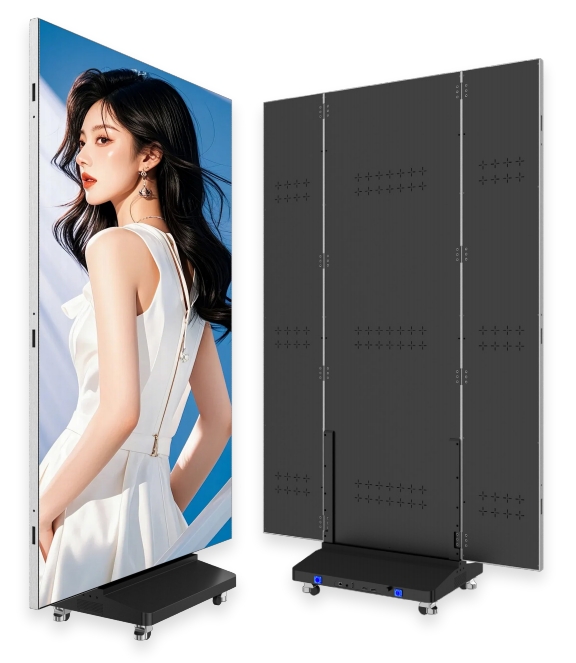
In visual communication, LED walls are pivotal. Their performance hinges on two core principles: Color Consistency and Contrast. These are not just technical specs but the foundation of effective messaging and immersion.
Why Accurate Color Matters
Accurate color ensures brand colors are true, artistic visions are preserved, and data is represented correctly. Inconsistency undermines professionalism and can lead to misinterpretation.
Impact Across Industries
Broadcast & Advertising: Ensures brand integrity and visual continuity across screens.
Events & Entertainment: Creates immersive, impactful experiences with vivid imagery and deep blacks.
Control Rooms & Retail: Enables accurate data reading and showcases products in their true colors, reducing eye strain.
What Determines Color Consistency in LED Posters
Color consistency refers to the uniformity of color and brightness across the entire display surface. In an LED poster, a lack of it results in visible patches or bands of color, ruining the visual impact. It is determined by a combination of hardware and software factors.

Key Determinants:
LED Bin Selection (Binning):
This is the most critical factor. LEDs are mass-produced, resulting in natural variations in color and brightness. Manufacturers sort them into “bins” of similar performance.
High-quality posters use LEDs from a very tight bin range, ensuring all pixels start with nearly identical characteristics.
Lower-quality posters use LEDs from wider bin ranges, leading to inherent inconsistency from the start.
Calibration & Compensation:
Even with tight binning, microscopic differences remain. High-end LED posters undergo point-by-point calibration.
Each individual LED’s brightness and color output is measured and assigned a unique compensation value.
The controller uses these values to adjust the input signal, forcing every LED to output the exact same color and luminance at a given command.
Drive Electronics & Control System:
The precision of the driver integrated circuits (ICs) that power the LEDs is vital. They must provide stable, uniform current.
Fluctuations in power or current from the drivers can cause LEDs to dim, brighten, or shift color.
The processing system must be capable of handling the vast amount of calibration data for every pixel.
Thermal Management:
LED color and brightness are sensitive to temperature. An LED that is overheating will behave differently from a cool one.
Effective heat sinks and thermal design prevent “thermal drift,” ensuring consistency is maintained even after the poster has been on for hours.

What Affects Contrast in LED Posters?
Contrast is the ratio between the brightest white and the darkest black a screen can produce. High contrast is crucial for image depth, clarity, and vibrancy. In LED posters, it is primarily determined by the ability to achieve a true, deep black.
Key Factors Affecting Contrast:
Black Level (Dark State):
This is the most critical factor. Unlike projectors or LCDs, LEDs produce black by simply turning off. Therefore, the perfect black level is zero light.
The main enemy of a true black is light pollution, both from the environment and internally from the screen’s own structure.
LED Packaging Technology:
Standard LEDs: The LED chips are mounted on a reflective surface. Ambient light hitting this surface is reflected back, “washing out” the black areas.
Black LED Packages: Advanced LEDs are housed in a black, non-reflective resin or casing. This dramatically reduces reflected ambient light, allowing the “off” pixels to appear much closer to true black.
Cabinet and Surface Treatment:
The mask (the black front surface between the LEDs) and the cabinet should have a matte, low-reflectance coating.
A glossy or reflective mask will catch and bounce ambient light, significantly raising the black level and reducing perceived contrast.
Brightness (Luminance):
While black level is paramount, a high peak brightness also contributes to the contrast ratio. A screen that can output a very bright white in combination with a deep black creates a more dynamic and impactful image.
Effective local dimming (controlling zones of LEDs) is less common in fine-pitch posters but can help in darker areas of an image.
Best Practices to Improve Color Consistency in LED Posters
Achieving perfect color consistency requires a proactive approach, combining careful hardware selection, sophisticated calibration, and ongoing management. Here are the key best practices.
1. Source High-Quality LEDs with Tight Binning
Practice: Insist on LEDs from manufacturers that use very tight “binning” ranges for wavelength (color) and brightness (luminance).
Why: This ensures all LED chips start with nearly identical characteristics, minimizing the inherent variation that calibration must later correct. This is the foundation of consistency.
2. Implement Comprehensive Point-by-Point Calibration
Practice: Perform a full 3D Color Calibration (measuring Red, Green, Blue, and White points) for every single pixel using a professional spectrophotometer or colorimeter.
Why: This is the single most effective step. It measures the tiny differences in each LED and creates a unique compensation matrix. The display’s controller then uses this data to adjust the drive signal for each pixel, forcing them all to output the same color and brightness at any given grayscale or color value.
3. Ensure Stable Drive Current and Power Supply
Practice: Use high-quality driver ICs that provide a stable, constant current and robust power supplies with minimal voltage fluctuation.
Why: LED color and brightness are sensitive to electrical current. Inconsistent power leads to drift, where LEDs change their output based on the electrical environment rather than the digital command.
4. Design for Effective Thermal Management
Practice: Incorporate adequate heat sinks and ensure proper ventilation in the poster’s design. Avoid enclosing the poster in a way that traps heat.
Why: LEDs shift in color and lose brightness as their temperature increases (“thermal droop”). Effective cooling ensures all LEDs operate at a similar, stable temperature, maintaining the accuracy achieved during calibration.
5. Perform Regular Recalibration
Practice: Establish a schedule for periodic recalibration (e.g., annually or biannually, depending on usage).
Why: LEDs age at different rates, with some colors (typically blue) degrading faster than others. This causes the initial calibration to become less accurate over time, leading to a gradual loss of color uniformity. Recalibration restores the display to its original pristine state.
Conclusion: Achieving Professional-Grade LED Visual Quality
In today’s competitive visual landscape, achieving professional-grade quality in LED posters is not merely an option – it’s a strategic necessity. The journey to excellence rests on two fundamental pillars: perfect color consistency and superior contrast performance.

True excellence is realized when these technical capabilities work in harmony:
Precision-calibrated colors ensure brand integrity and artistic authenticity
Deep, true blacks create the visual depth and impact that captivate audiences
Advanced thermal management maintains this performance hour after hour
Regular recalibration preserves the investment over time
The most successful implementations recognize that quality is not just measured by specifications, but by the emotional impact on viewers and the strategic value delivered to clients. By implementing the best practices outlined – from careful LED selection to sophisticated calibration and thermal design – your LED posters can transcend being mere displays and become powerful tools for communication, engagement, and brand excellence.
Ultimately, professional-grade quality is what separates simply showing content from creating unforgettable visual experiences that deliver measurable results.